
When I first started supporting hardware teams, one of the most common questions I heard was: “Should I use an FPGA or a microcontroller?” Both can run logic, but they work in completely different ways. Understanding these differences helps you choose the right architecture from the start.
**An FPGA is a reconfigurable hardware chip for parallel logic processing, while a microcontroller is a fixed, programmed processor designed for sequential tasks and everyday control func
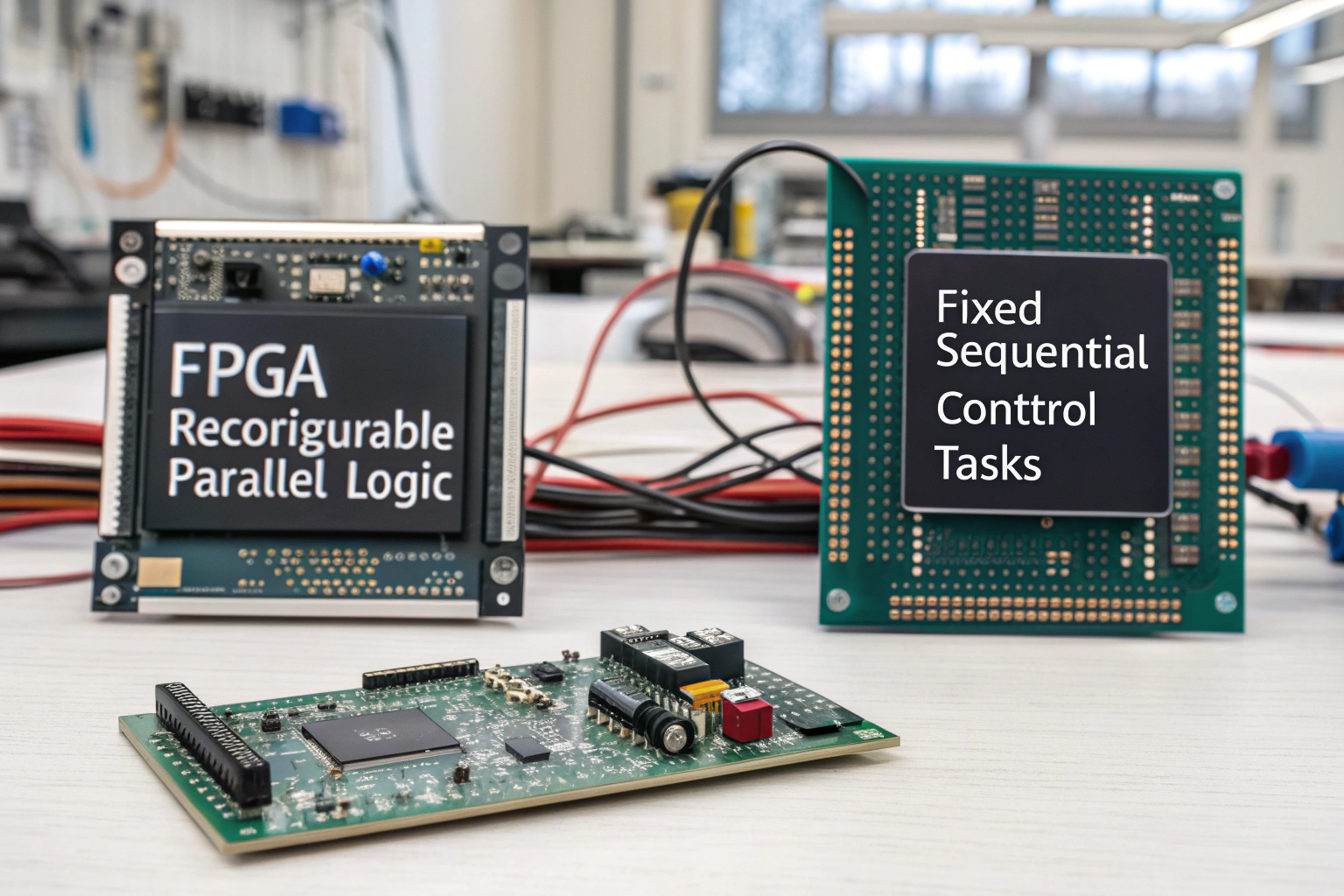
A clear comparison helps you avoid over-design, control your BOM cost, and match the device to your product’s real needs. Let’s walk through the essential questions.
What is the core difference between an FPGA and a microcontroller?
This question often appears when customers evaluate performance requirements. Many people assume they are similar because both involve code, but they operate very differently.
The core difference is that an FPGA uses hardware-level logic blocks for parallel processing, while a microcontroller uses a CPU that executes instructions one by one.
How each device works and why the difference matters in real products
An FPGA (Field Programmable Gate Array) is built from configurable logic blocks, lookup tables, and routing matrices. You design hardware behavior using HDL (like Verilog). This gives you custom hardware performance without building a dedicated chip.
A microcontroller (MCU) is built around a fixed CPU core with memory and peripherals. You program it in C/C++, and it executes instructions like a small computer.
Here is a clear comparison:
| Feature | FPGA | Microcontroller |
|---|---|---|
| Processing style | Parallel | Sequential |
| Flexibility | Very high | Limited |
| Speed | Extremely high for custom tasks | Good for general tasks |
| Power usage | Higher | Lower |
| Development | HDL-based | Firmware-based |
| Cost | Higher | Low to moderate |
| Best for | Custom logic, high-speed control | Everyday electronic control |
In my factory’s engineering reviews, choosing between the two usually depends on speed, timing precision, and logic complexity. Using an MCU when you need parallel logic can limit performance. Using an FPGA for simple control can waste cost and power.
When should you choose an FPGA and when should you choose a microcontroller?
Customers often ask this when designing new systems. Selecting the wrong device can cause redesigns, delays, and unnecessary cost.
Use an FPGA when you need high-speed parallel processing or custom hardware logic. Use a microcontroller when you need low power, simple control, and cost efficiency.
A deeper guide to help you decide based on real engineering needs
Choose an FPGA if your design requires:
- High-speed data processing
- Real-time signal manipulation
- Parallel tasks
- Complex timing control
- Hardware-level customization
- High-speed interfaces like PCIe, LVDS, MIPI
Examples from past customer projects:
A client designing a high-speed vision processing module used an FPGA because an MCU couldn’t handle the parallel pixel processing. Another team working on motor control used FPGA logic to achieve nanosecond accuracy.
Choose a microcontroller if your design requires:
- Simple logic or control loops
- Low power consumption
- Battery operation
- Standard communication (UART, I2C, SPI)
- Cost-sensitive mass production
Examples from my experience:
Most IoT controllers, sensor modules, and smart-home boards use MCUs. They’re small, cheap, and easy to program.
Comparison table:
| Requirement | Best Choice | Reason |
|---|---|---|
| High-speed parallel logic | FPGA | Custom hardware |
| Low power and long battery life | MCU | Efficient CPU |
| Complex signal processing | FPGA | Parallel execution |
| Simple automation/control | MCU | Simpler development |
| High-volume production | MCU | Lower BOM cost |
| Frequent design changes | FPGA | Reprogrammable hardware |
During early DFM reviews, we help teams match device choice to cost, SMT process, availability, and thermal behavior. Many clients say this saves them weeks of guessing.
Although they are different, they still overlap in some areas. This sometimes confuses new engineers.
Both FPGAs and microcontrollers control electronic systems, interface with sensors, and run logic that manages real-world hardware.
Both devices can:
- Process input signals
- Control outputs (motors, LEDs, relays)
- Communicate using digital interfaces
- Run embedded logic
- Integrate into PCBs with similar power and layout needs
Both may require:
- Stable power design
- Decoupling capacitors
- Correct footprint and pad layout
- Reflow-friendly package choices
- Functional testing after assembly
In my production work, I’ve handled both FPGA boards and MCU boards. While their internal logic differs, their PCBA requirements—such as BGA soldering, impedance control for high-speed lines, or stable power design—are similar.
This is why we always check packages, pad sizing, via design, and thermal behavior before fabrication. Both device types will fail if PCB design isn’t done correctly.
Conclusion
FPGAs and microcontrollers serve different engineering purposes, but both are essential building blocks in modern electronics. FPGAs offer unmatched speed and parallel processing, while microcontrollers deliver simplicity, efficiency, and low cost. When you understand their strengths and limits, you can choose the best device for your product and build hardware that performs reliably from prototype to final production. With the right planning and engineering support, you can move confidently from concept to a stable working design.
